Wilted flowers as testimony to former glory now past its prime may be attributes of womanhood. And of fertility, for every angel of annunciation in 15th century paintings carries a flower, usually a lily and not a rose. They use it to reveal themselves as the ones bringing Mary the tidings of her immaculate conception. It is and will remain a mystery: so be it, the world is full of them. In this particular case, however, the bunch of flowers is not a typically female attribute but stands for the fragility of human beings.
Usually the bunches are drawn with black charcoal into the superimposed paint layers. This heightens the effect of fragility. The dark area lying beneath is often exposed. Perhaps “Les Chants de Maldoror” by the Comte de Lautréamont, a text the Surrealists picked up on much later, are shining through here. The author is called – a quaint detail of history – the grandfather of Surrealists, which seems strange given that he died when only 24 years old. The texts by this poet, whose life is only known in part and whose work has survived only in fragments, are spheres of association where it is good to dwell and work.
Death is only a part of life and should not be confused with darkness and depression. Hardly anyone understands that. But I immediately realised that the paintings and videos by Patricia Reinhart are not about sobbing in a dark basement.
The element of drawing and the reduction to single lines filter out what is anatomically unimportant. And the figures always keep a critical distance to the world around them. They deliberately seek a place outside of society and their innermost feelings are not disclosed. Their humanity is in conflict with the outside world that shines in through a train window or shimmers through tendrils of flowers on to nocturnal black.
It befits the beautiful, palely made up faces of the silent movie stars depicted, strong women who vanished from prominence as silent movies became talking movies. By that time they had already profoundly changed the image of women in society and given a voice to the simple women in the street. Melodrama, the classical genre for women, was studded with angels and vamps to be appreciated by switchboard girls and shop girls who finally had the freedom to roam the streets of big cities and smoke cigarettes. Lyda Borelli, a silent-movie star from the 1910s, avoided the shame of being discarded by retiring from the screen prematurely. Others, such as Asta Nielsen, were hit harder.
Painting is a real struggle, as is life. It can happen that a painting is destroyed at the drop of a hat. A tiny moment of carelessness and the composition will be lost beyond rescue. The black reminds one of a blackboard on which one can write with a lacquer pen. Shiny and matte areas alternate. In some places the paint runs or streaks and the world or some of its details become blurred.

13 poémes visibles
Super8-Filminstallation
Ophelia, Super8-Film, ciné collage, 1 min., 2009/2010
avant de mourir, Super8-Filmloops, ciné collage, 2009/2010
Installation View, Super8 - Filmloops, 2010
Films:
nocturne in schwarz, ciné collage, colour, 3.22 min., 2008
Kirkirerland, Super8-Film, ciné collage, colour, 1.10 min., 2008
4.Akt Lyda´s death, ciné collage, 3.50min., 2007
untitled/silentmovie, ciné collage3min, 2006
Der bittere Beigeschmack, Cinè collage, 3min, 2006
Heroes&Loser, Cinè collage, 3 min, 2005
Kids, 1 min, 2005
the adventures of santa fe and rick castle, cine collage, 2.30 min, 2004
Zug, Cinè collage, 1.30min, 2004
Barbara & Paul, Cinè collage, 2.30 min, 2004
Blindness, 3 min, 2004
Triple Tak, Cinè collage 4.30min, 2004
Fight, 1min, 2004
Somethings stilling, 3.30min, 2004
Watschn, 2.40min, 2004
Depeche mode dancer, 2.30min, 2004
Kànikula, 7min, 2003
Chercher le destin, 7min, 2001-2003
Untitled (Statuen),C-Print, 21x30cm, 2010
contact
Tel.: +43 / 699 / 192 587 13
Mail: patriciareinhart@gmx.at
|
|
Rosa, oil on linen, 150 x 175 cm, 2010
Cross fading to the video: created in painstaking detail from still photographs. The ciné-collage is a one-woman production and the decision to do it alone was not informed by economic constraints but taken very deliberately. After all, painting, the root cause of all action in this case, is not a task one would share either. It takes enormous time to produce the films, but at the end of the day the animation and montage is not monosyllabic, for it always relates to its point of reference and departure: painting, the starting point of all activity in this universe. Media hopping. And the motifs/themes/issues are addressed at several levels: painting, drawing, video.
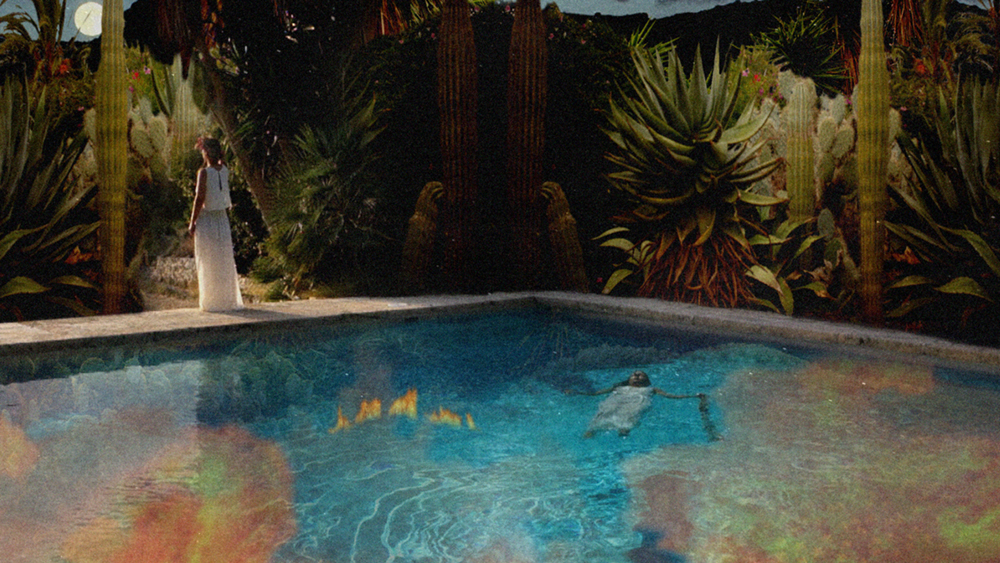
The collection of figures roams through landscapes and rooms in stop-and-go motion. The stop-and-go element exacerbates to grotesque levels the silent-movie gesture, which this is all about and which is full of pathos to begin with. The ciné-collage is surrounded by stage-setting, an important element. Nothing is left to chance. The collage is embedded in a glowing sea of candles, between wreaths and floral decorations. Gauze, moved by a sea breeze, acts as a canvas. What is the most important thing?
Nostalgia, the darkness, the nights as arenas of fear and oppression. The clouds of an agitated sky are suddenly moving across a festive hall decorated in sumptuous art nouveau. In the mirror one sees a pale-skinned beauty lounging seductively, the abundant blond hair of her wig flowing across her body like a waterfall. Mirrors create confusion: reconstructions of the self in shiny variations, explored by psychoanalysis down to the profoundest depths. Abysses. Monsters. The woman being kissed moves in fitful jerks, like a puppet on a string.
Is she giving in to the kiss or struggling against it? Is the kiss an assault or the expression of lust? Beautiful corpses gliding past. On the Styx river into the Hades of movie history. Accompanied by sounds going back to Henry Purcell. Edited, mixed and altered with great dedication. One would like to swim along and dive into this cosmos, to experience the longing and look into another world before it pales, disappears and becomes irretrievably
lost. (Text: Petra Henninger)
Ophelia, oil on linen, 175 x 150 cm, 2010
biography
Solo: 2008 NOCTURNE, Künstlerhaus Passagegalerie, Vienna
/ THE SILENCE WAS VAST, Gallery Dana Charkasi, Vienna /
2007 LYDA´S DEATH, Oficina#1, Caracas, Venezuela
/ 2006 THROUGH WOODS AND MEADOWS, Gallery Dana Charkasi, Vienna
/ 2005 HEROES & LOSER Das Fotostudio, Vienna
/ TRUST ME (marks blond project) Sammlung Häuser und Wir, Zürich /
2004 I LEFT PARIS BY A ONE-WAY STREET Brick-5, Vienna
/ FLIRT ME Marks blond project, Bern
/ MY NEONLINE PAINTINGS Atelier Quelle, Vienna
/ 2003 *) , Daponte, Vienna
/ 2002 TRÄUME ICH NOCH IMMER?, Artothek-Galerie Alte Schmiede, Vienna
/ 2001 OUVERT, Citè Internationale des Arts, Paris
/ 2000 DER TRAUM EINES ENGELS, Projectroom Muntean/Rosenblum, Vienna
Group: 2010 Kerstin Engholm Gallery, Vienna / 2008 AUSTRIA conTEMPORARY, Essl Museum, Klosterneuburg/Vienna
/ BOLOGNA CHICKS, Marks blond, Bern
/ ANTON FAISTAUER PRICE, Galerie im Traklhaus, Salzburg
/ 2006
EXPERIMENTAL JET-LAG, Paris
/ 3 generations - 3 regions, Burg Schlaining, Schlaining
/ 2005 MARKS BLOND HOLYDAYS, International Biennale of contemporary art, Prague / ART 36 BASEL, Galerie Scalo, Switzerland
/ BEFORE SUMMER, Atelier Quelle, Vienna
/ flexibition #4. Sehnsucht. Gallery HATSOV, flat exhibiton room, Vienna
/ 2004
BOOK+PORTFOLIO, Betonsalon, Paris /
2003 PFANN OHMANN PRICE, Künstlerhaus, Vienna
/ 2000 PATRICIA WIRD ERWACHSEN, Semperdepot, Vienna
/ ROTKÄPPCHEN HAT GEBURTSTAG, Club U, Vienna
/ 1998 MEISTERKLASSE SUE WILLIAMS, Kupferstichkabinett, Vienna /
SPICES & DIVERSITIES & ACADEMIES, curator: Harald Szeemann, Semperdepot, Vienna
Videoscreenings:
2010 700IS Reindeerland, experimental film and video festival, Iceland, Norway, Arizona, Hungary, UK, Portugal / 2008 AN DEN GRENZEN DER BEGRIFFE - ARBEITEN MIT DER
FILMKAMERA, curator: Günter Puller,
Filmfestival Bayreuth, Germany,
Topkino, Vienna,
General Public, Berlin /
2007 LYDA´S DEATH (Oficina#1), Playa Grande, Choroni, Venezuela
/ 2005 BLACK IS BEAUTIFUL (marks blond project) Whitespace, Zürich
/ 2003 Matchcuts, Votiv 21, Vienna
/ 2002 Super 8 – Festival, Paris
Honours/Awards:
2007 Projectscholarship - Venezuela, Office of the Federal Chancellor, Austria /
2006 Projectscholarship - Paris, Office of the Federal Chancellor, Austria
/ 2002 scholarship, Emanuel Fohn-foundation, Vienna
/ 2001 Artist-in-Residence, Cité Internationale des Arts,scholarship for Paris, Office of the Federal Chancellor, Austria
/ scholarship, Emanuel Fohn-foundation, Vienna
/ 1999 achievement scholarship, Academy of fine Arts, Vienna
/ 1998 master school price, Academy of fine Arts, Vienna
Public Collections:
Essl Collection, Austria / Office of the Federal Chancellor / Municipal Council of Vienna, Austria
Education:
1995 – 2000 Academy of fine Arts, Vienna
(Wolfgang Hollegha, Sue Williams, Muntean/Rosenblum) / 1999 – 2001 study of acting, Gustav Mahler-conservatory, Vienna
Catalogue/Critics:
AUSTRIA conTEMPORARY - emerging artists, Sammlung Essl, Klosterneuburg (ed.), 2008
/ Anton Faistauer Preis, Galerie im Traklhaus, Salzburg, 2008
/ Christa Benzer: Der Standard, 2008 /
Nicole Scheyerer: Die Presse, Vienna, 2006 /
Academy of fine Arts. diplomwork 2000, Academy of fine Arts Vienna (ed.) 2000 / Muntean/Rosenblum: Art after the Turn of the Millennium.Academy of fine Arts (ed.) Vienna, 1999 |