Zum Inhalt springen

Paintings

In the 20th century, purposely perforating or damaging the canvas became a means of expression and a symbolic gesture. It elevated the violent and destructive to an aesthetic element, but also stood for a reaching-out into new dimensions, simultaneously emphasising the presence of the real and the metaphorical in painting: Niki de Saint Phalle shot her reliefs in an emancipatory act, Joan Miró presented Burnt Canvases as a protest against political oppression and the reduction of art to a commodity for an elitist society. Finally, Lucio Fontana ventured to expand the limiting area of the canvas with his Concetto spaziale and open it up to infinite space. These artists worked – each in their own way – with a negative surface, a literally empty space, which – in the form of holes, perforations, cuts or cut-out surfaces – acquires creative power, not only represented, but actually present.

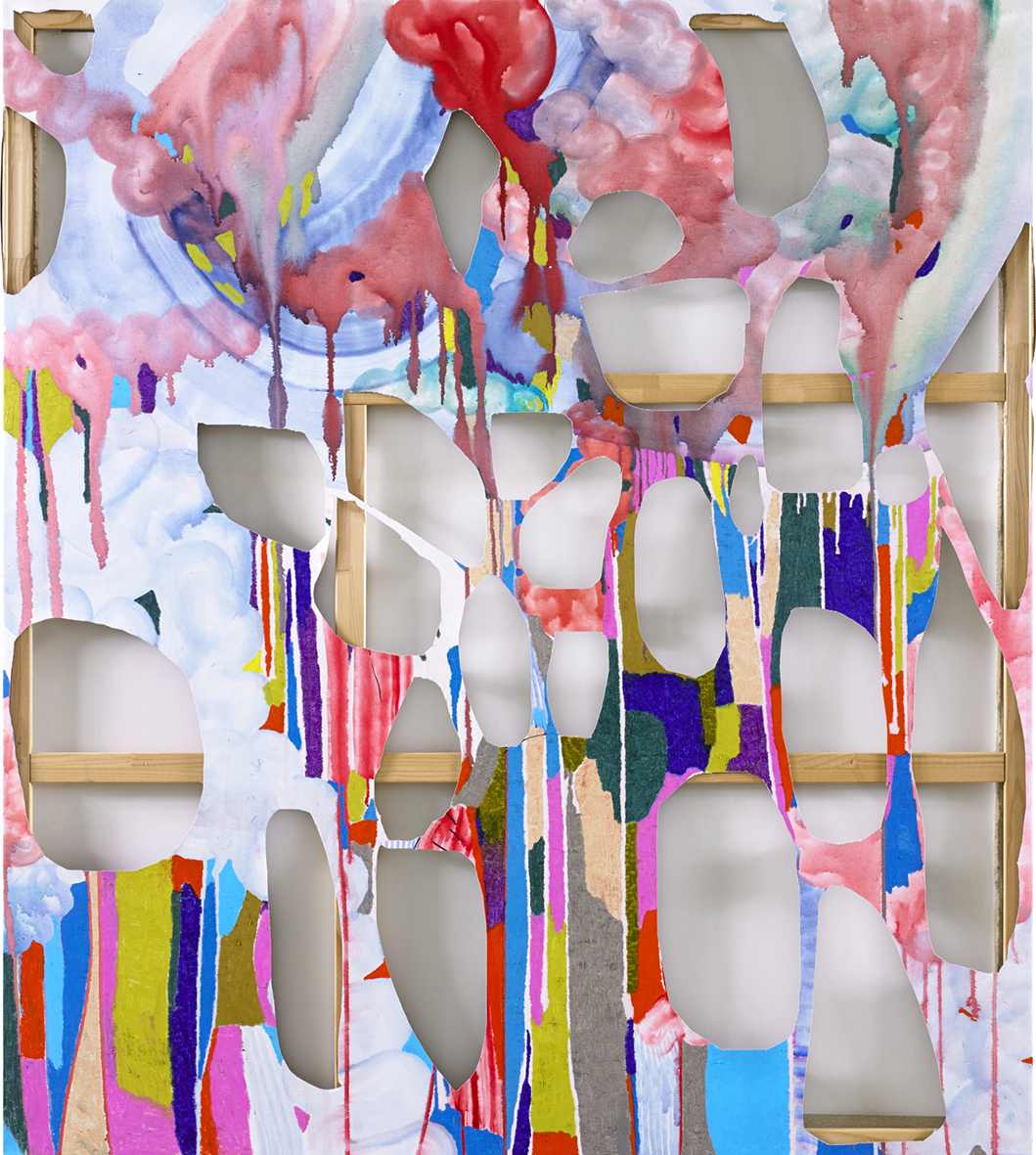
Coïncidences III, watercolour / oil pastel on linen, 170 × 150 cm, 2021 © Photo credit: Daniela Beranek

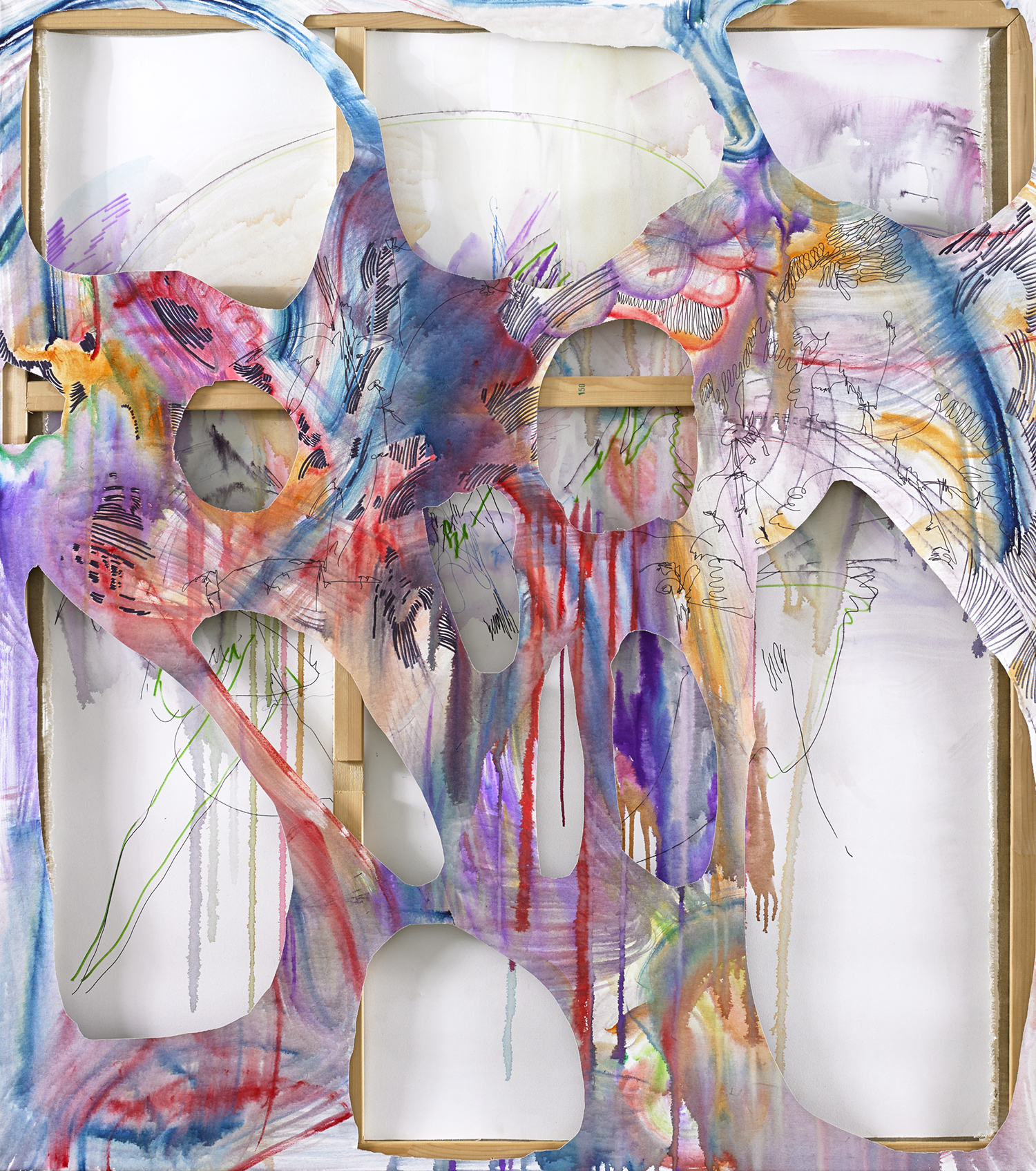
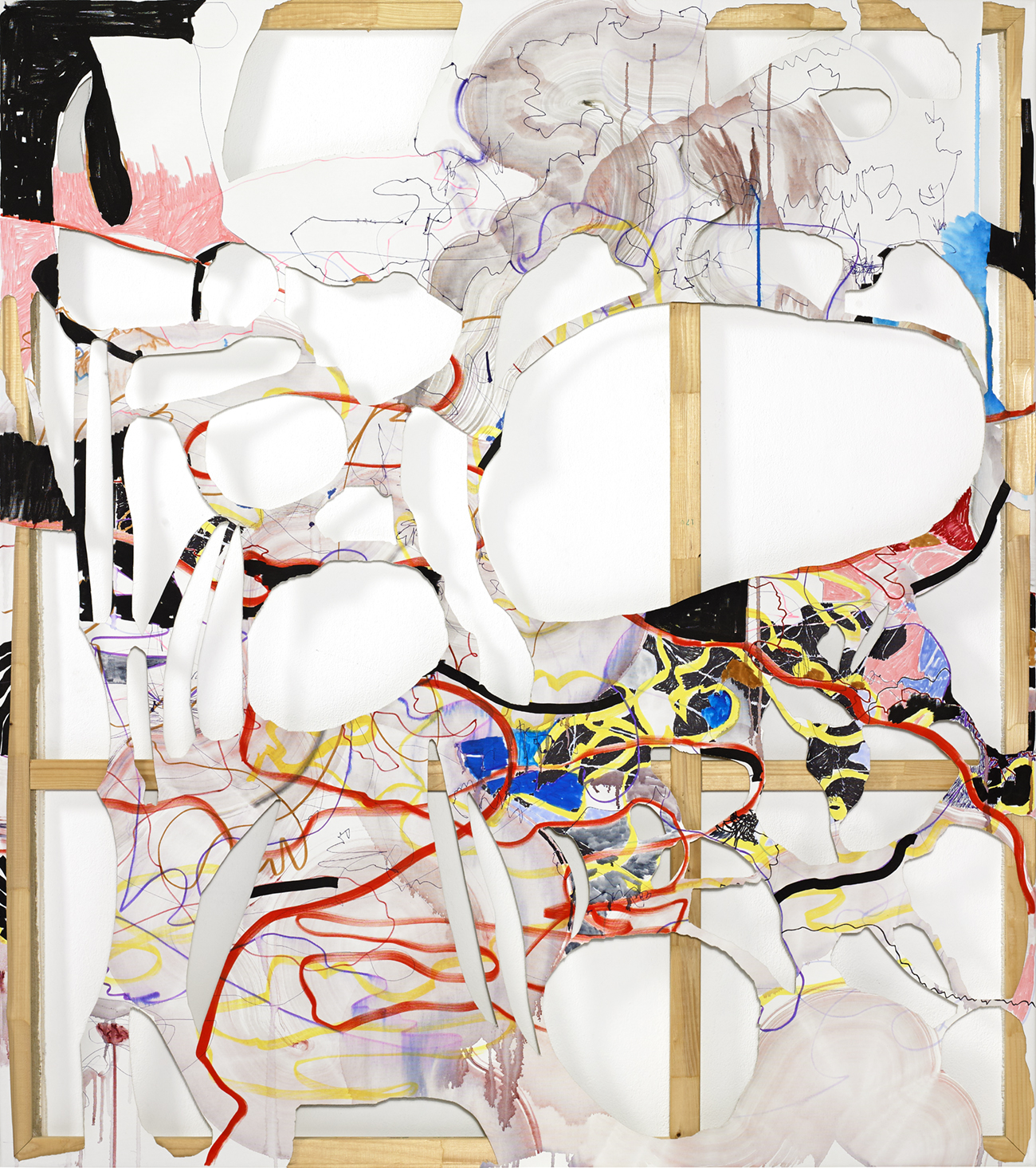
In her Cut-Outs, Patricia Reinhart uses the cut as a precisely- calculated technique that does not destroy the painted forms of her pictures, rather imitates them. She cuts into or out of compositions in a controlled and precise way, using the knife like a scalpel for correction. The art of painting becomes sculptural at this moment, its fragility disturbed. It resembles making a sculpture out of the canvas when the artist takes out those parts of the painting, like taking them out of a body. They need to be removed in order for the painting to function. Glimpses and lines of sight emerge onto something behind, onto the wall behind the canvas or into another room; as “sandwich paintings” they are layers that double the painted space as a painting in front of the painting. Many Cut-Outs make the stretcher frame visible on which the canvas, which is only present in narrow sections, is mounted. In front of the wall, the Cut-Outs cast shadows, they create optical effects like shapes, so that the illusion of painting, which requires a uniform surface, is disrupted by real space.

Untitled (NM), mixed media on canvas, 170 × 150 × 5 cm, 2021 © Photo credit: Daniela Beranek

Patricia Reinhart does not use watercolours in a conventional manner. Rather, her specific production method consciously incorporates the flowing properties of watercolour, such as the running and trickling down of the paint or its surface-like spread, into compositions created intuitively and without preliminary drawings directly onto the blank canvas, employing them to create certain aesthetic formations. This technique also seemed suitable for the representability of inner, unconscious and emotional processes and spaces. Works such as XXV – W VI (Sleep 5/3) (2021) or Cut-Out / Lucid Dream (2018) betray an inspiration from the field of psychoanalysis. A visualisation of psychic structures is not programmatically artistic, but part of a self-referential search for the truthful, the authentic, the metaphysical – a form of meditation characterised by authenticity: ”The stroke is real, it has its own tension, and it is an intimate act of painting“, says the artist.

The colour orgies of her paintings radiate a sensuality that is at once powerful and delicate, combining small-scale forms into larger dynamic patterns of movement. They are forces rather than calculated formations. They also reflect the artist’s interest in colour materiality, its varying density, its properties and possibilities of articulation, its non-illusionistic roughness, its sensitivity associated with femininity.

Patricia Reinhart uses the entire colour spectrum, which manifests inherent principles of optics and physics, transforming the work into a painterly space of experience within which we are encouraged to dream.

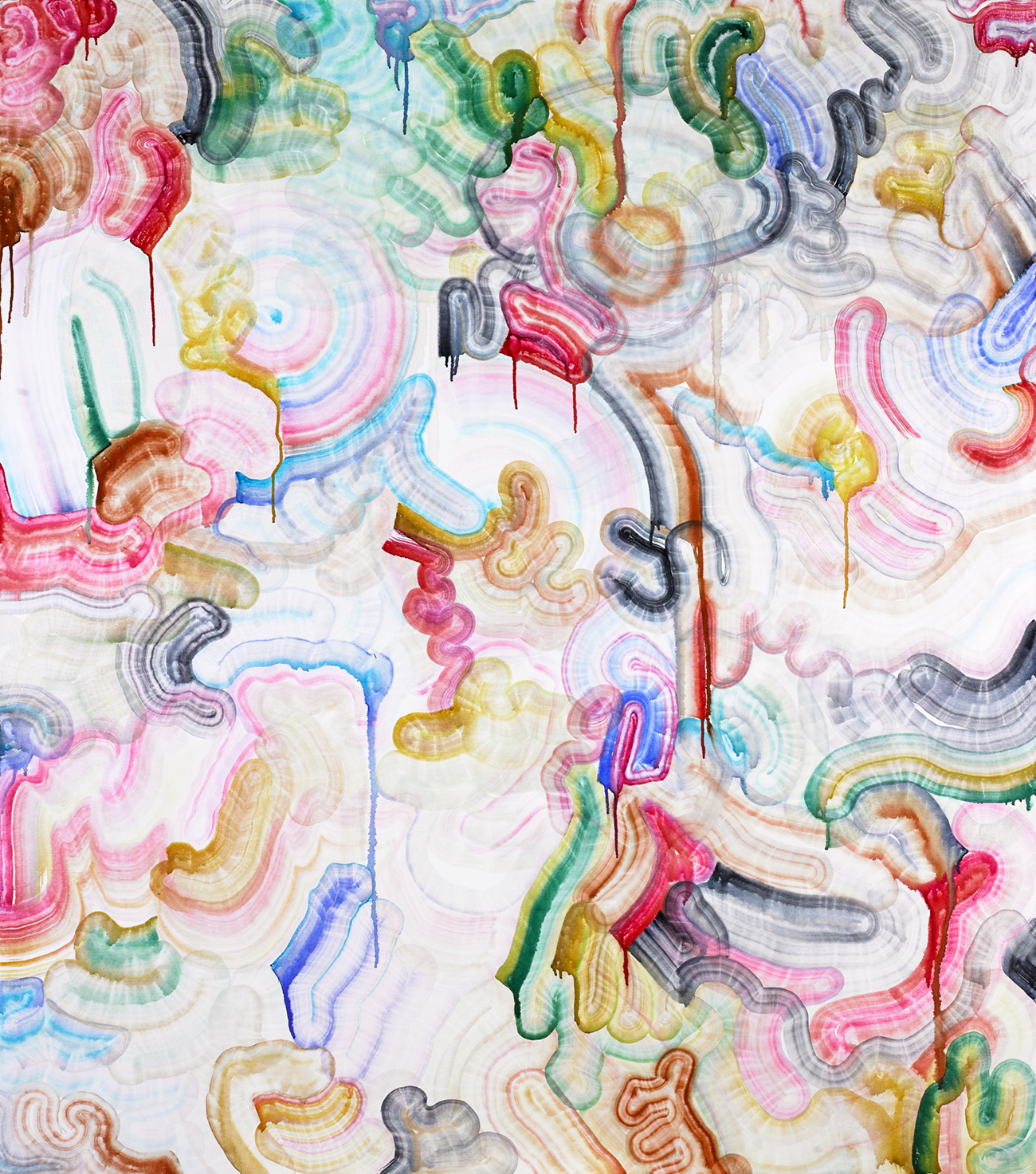
Untitled, watercolor on canvas, 170 × 150 cm, 2019 © Photo credit: Daniela Beranek

Abstract colour/form structures can be interpreted as expandable inner space and as the idea of a cosmic space that points to an infinite vastness. Their respective sections can be continued infinitely, since they are not limited by the representational. Such a “surveying of the world”, as Patricia Reinhart has called a series of paintings (NM, 2020–2022), visualises itself abstractly as an expression of imagination. Depth of space is created by layers of light-dark contrasts formed by a staggered juxtaposition and superimposition of delicate and strong colours, i.e. thinner or thicker applications of paint in different formations. Drawn elements crisscross the polymorphous colour structures and are reminiscent of circles, diagrammatic fragments or spatial markings. Bubbling skies, fireworks, explosions, storms or energies in constant flux as visualisations of inner states suggest that the infinity of space can be experienced inwardly rather than through an objective view. It is true that we sense an infinite space when looking toward the horizon at sea, in the clear night sky or when flying above the clouds. Since infinity does not permit an all-encompassing view, we can only grasp this space visually as a fragment or symbol. Painted infinity spans a symbolic space on the canvas, the extension of which is left to the imagination. One familiar cultural symbol for a material and mental, psychic or spiritual space that is doubly imagined in this way is the heavenly paradise, which, on Earth, manifests as a garden. Patricia Reinhart’s series Paradise I–III (2018–2020) is dedicated to this construct.

Cut-Out, watercolour / acryl / marker on linen, 170 × 150 cm, 2017 © Photo credit: Daniela Beranek

Patricia Reinhart’s multi-part series Coïncidences (2021/22) or Patience (2015/16) are conceived as analogies between abstract forms and abstract concepts of space, time and encounter. Colour in particular, condensed through its properties into materiality, establishes close relationships between material and non-material worlds. Colour can be a starting point for considerations on a physical, neurological or psychological level that breach inner and outer spaces alike. It guides us into the realm of mysticism on a cultural level or into quantum physics on a scientific level. As subjective expression, Patricia Reinhart’s painting approaches those superordinate laws inscribed on the world, even as its form aesthetically links it to non-visible aspects of human existence. // Excerpts from Synne Genzmer’s text featured in the monograph ‚Patricia Reinhart,‘ published by Verlag für moderne Kunst, Vienna, 2022.

Patricia Reinhart’s “Wing” series unfolds as a painterly topology of the threshold. The canvases negotiate a movement between suggestion and abstraction, between tectonic tension and organic condensation at the border between figuration and abstraction. The title „Wings“ refers to a sacral iconography whose art-historical depth activates sacred pictorial traditions as well as physiognomic, zoological, and metaphysical structures. In several works in the series, such as „Die Vermessung von Liebe I (zweiter Flügel)“ (The Measurement of Love I (Second Wing)), „Flügel IV (Sandwich IV)“ (Wing IV (Sandwich IV)), and „Flügel V“ (Wing V), this reference appears structurally: as an allusion to a musculoskeletal system, as the remnants of a feathered system, and as traces of a translucent membrane.

This reference is particularly striking in „The Measurement of Love I (Second Wing),“ which formally refers explicitly to Albrecht Dürer’s study of a bird’s wing. Patricia Reinhart adopts the basic format, the composition along a slight diagonal, and the auratic isolation of the wing as the subject of the image. The color scheme, warm brown and copper tones broken up by fine white highlights, also evokes a closeness to Dürer’s original. But where Albrecht Dürer designs the wing as a manifesto of naturalistic precision and divine order, Patricia Reinhart deconstructs this order into a painterly syntax of displacement. The brushstrokes in „The Measurement of Love I (Second Wing)“ break down the feather structure into vibrant clusters of lines, and the original tectonics are overlaid with flowing layers and striking crossings-out. The signature that Albrecht Dürer placed in the lower left corner of his sheet as a sign of identity appears in Patricia Reinhart’s work as a visual trace: formally quoted, but semantically open. This refraction transforms the iconographic reference into a critical gesture. What appears to be an order of knowledge in Albrecht Dürer’s work coagulates in Patricia Reinhart’s work into a palimpsest-like field of resonance: image as archive and painting as a re-enactment of cultural coding. The wing functions here as a structural support: for lightness and load, for semantic overload and formal erosion, for projection and subversion. In the dissolution of the clear feather structure in favor of gestural superimposition, the paradigm of the winged creature is reduced to its material conditions: as an organic fragment, as a memory of a possibility of flight that was never realized.

In their iconographic depth, Patricia Reinhart’s wing images touch on Albrecht Dürer’s natural history-based feather studies and, beyond that, join a visual genealogy of winged bodies whose historical span ranges from Fra Angelico’s seraphic beings of light to Hildegard von Bingen’s visionary cosmologies to Odilon Redon’s symbolistically enraptured angel figures. In all of the above cases, the wing appears less as an anatomical structure than as an epistemic instrument: as a vehicle of revelation and structural dislocation. Patricia Reinhart takes up these lines of tradition and transforms them into a contemporary form of painterly analysis. In Patricia Reinhart’s work, the wing becomes a zone of compression: a threshold between visibility and imagination, an aggregate state of form, color, gesture, and accumulated knowledge. This superimposition transforms the series into a distinct visual concept: a system of traces and structural memory that structurally reformulates the historical motif. 

In this series, Patricia Reinhart’s painting oscillates between the internal coherence of the composition and an overload of its semantic legibility. The strength of the series lies in this ambivalence: it alludes to the iconographic knowledge of the art system, quotes it with extreme precision, and at the same time eludes any affirmation. // Text written by Anne Avramut, Vienna 2026